Does Your Battery Warranty Protect Your Revenue?
Buying a battery storage system is a long-term investment with a high upfront cost. The investor gets stable revenues and a reliable payback only if the system keeps working within the agreed limits for its whole lifetime. Securing that is the job of the warranty contract.
For battery storage, a warranty contract usually has two parts:
- Standard warranty covers defects in materials or workmanship for a set period after the system is installed. If something fails because of a manufacturer's fault, the manufacturer repairs or replaces it.
- Performance guarantee is part of the same contract and sets the minimum performance of a fully functional system.
The standard warranty protects you when something breaks. The performance guarantee protects your revenue when nothing breaks, but the battery slowly does less.
Below is what every "good" warranty contract should contain.
1. Warranty period
We recommend an extended warranty with a total duration of 10 years, covering both wear and non-wear parts of the system. This is the only way to protect yourself against unexpected costs over the next decade.
2. Response time
The contract must state clearly how long the manufacturer has to respond to a reported fault (e.g. 48 hours). It must also define when you will receive an official answer and a proposed solution.
3. Repair time
It makes sense to set different repair times for different types of faults. For example: up to 15 days to fix a fault not related to the battery cells, and up to 30 days for a fault on the battery system itself.
4. System availability
Availability is the share of time the system is ready to operate. The manufacturer must guarantee a minimum availability (e.g. 98%, excluding routine inspections and maintenance). For larger systems, I suggest also agreeing on contractual penalties if availability falls below the agreed value.
5. Depth of discharge (DoD)
Batteries are usually not discharged all the way to 0% or charged to 100%, because that speeds up degradation. The most common range is 5–95% state of charge (SoC), which means 90% DoD. You lose part of the usable capacity and with it some profitability, but the battery lives longer.
For the investor, the key question is under which conditions the manufacturer guarantees the battery. These conditions are the basis for calculating the payback period and earnings, and for comparing different offers.
6. Performance guarantee
This is the manufacturer's commitment that the storage system will meet the technical parameters set in the contract: the allowed capacity degradation and the charging/discharging efficiency. Because this directly affects your revenues, the guarantee must be written very precisely. If capacity drops faster than agreed, you lose revenue.
The contract must also state exactly how often (e.g. once a year) and how the two key parameters, SOH and RTE, are measured.
What does the performance guarantee cover?
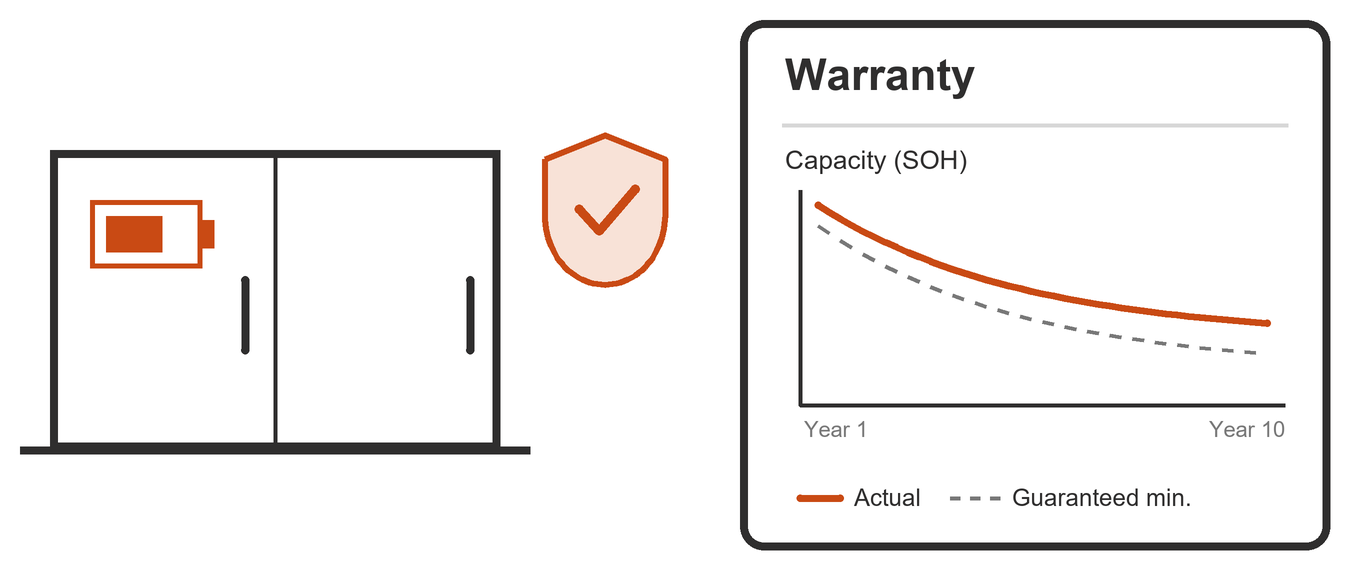
Degradation (SOH, state of health). It sets the minimum allowed capacity of the storage system for every year of operation. Typically, we expect a battery to still have at least 70% of its capacity after 10 years, although the final result of course depends on how the battery is actually used.
Round-trip efficiency (RTE). It shows how much energy you get out of the battery compared with how much you put in. Typical values are between 85% and 89%, and they drop by about 1 percentage point over the lifetime.
Here it is very important to check whether RTE includes the system's own consumption, e.g. energy for cooling, heating or other auxiliary systems. This consumption depends on the outside temperature and on how hard the cooling system works, so it changes the actual efficiency at any given moment. That is why contracts usually define RTE on the AC side, without own consumption, so that the conditions are more comparable.
An example of a performance guarantee table:
| Year of operation | Minimum SOH [%] | Minimum RTE [%] |
|---|---|---|
| 1 | 95.1 | 87.7 |
| 2 | 92.6 | 87.5 |
| 3 | 90.8 | 87.2 |
| 4 | … | … |
Conclusion
To sum up, a good warranty contract must include:
- a 10-year warranty for all parts of the system,
- clear deadlines for responding to and fixing faults,
- a minimum availability (e.g. 98%),
- the conditions of use (DoD, number of cycles per day, ambient conditions, etc.),
- and an exact performance guarantee table with the allowed SOH and RTE for every year.
If one of these is missing from the offer on your desk, ask for it before you sign.
If you find this blog useful, please share it with others and let me know your thoughts on LinkedIn!