What Should You Know Before Buying a Battery Storage System?
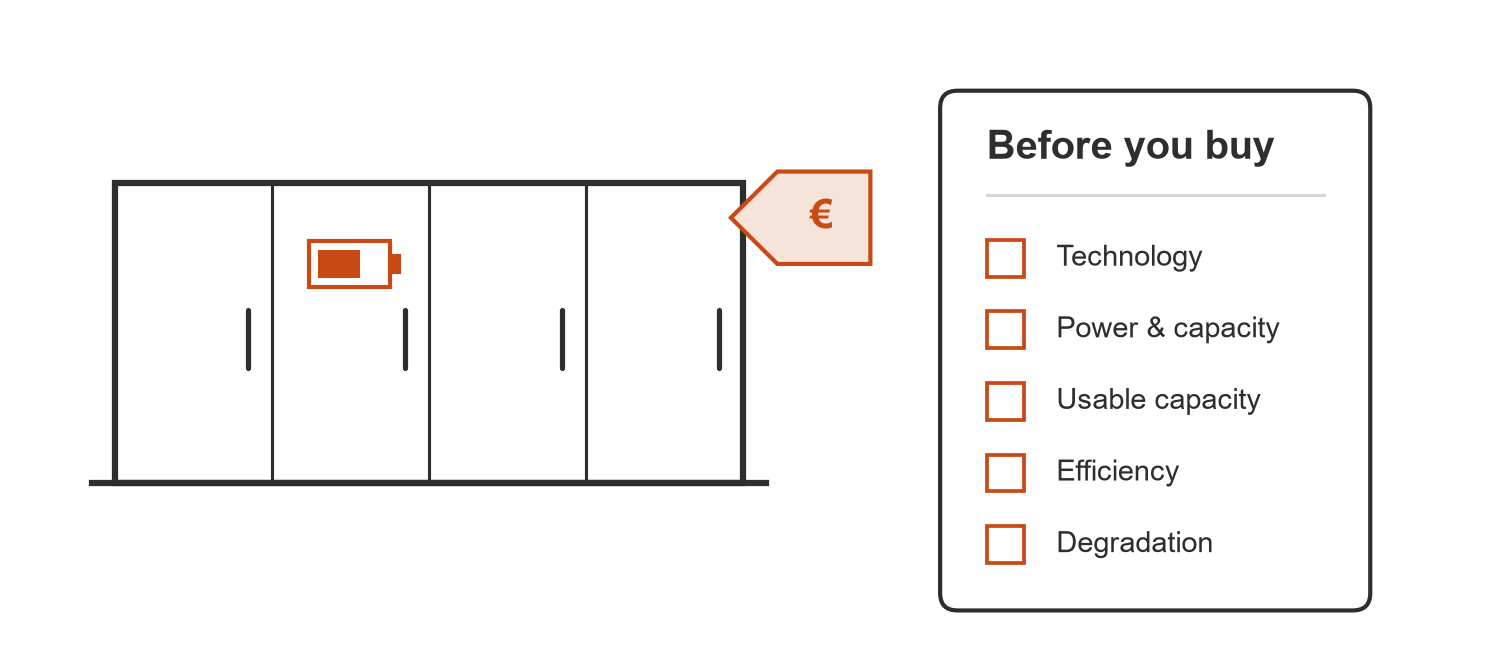
When a company buys a battery storage system, it wants a (1) short payback period and the (2) highest possible earnings. Both depend on a handful of numbers from the datasheet and agreements, and these numbers are usually measured under conditions you will never see in practice.
A datasheet tells you what a battery can do in the lab. Your business case depends on what it does on your site.
Here are the five things to check before you buy.
1. Which technology?
Today the market is dominated by lithium iron phosphate (LFP) batteries. A storage system is built from cells (3.2 V), connected into modules, then racks, and finally cabinets or containers.
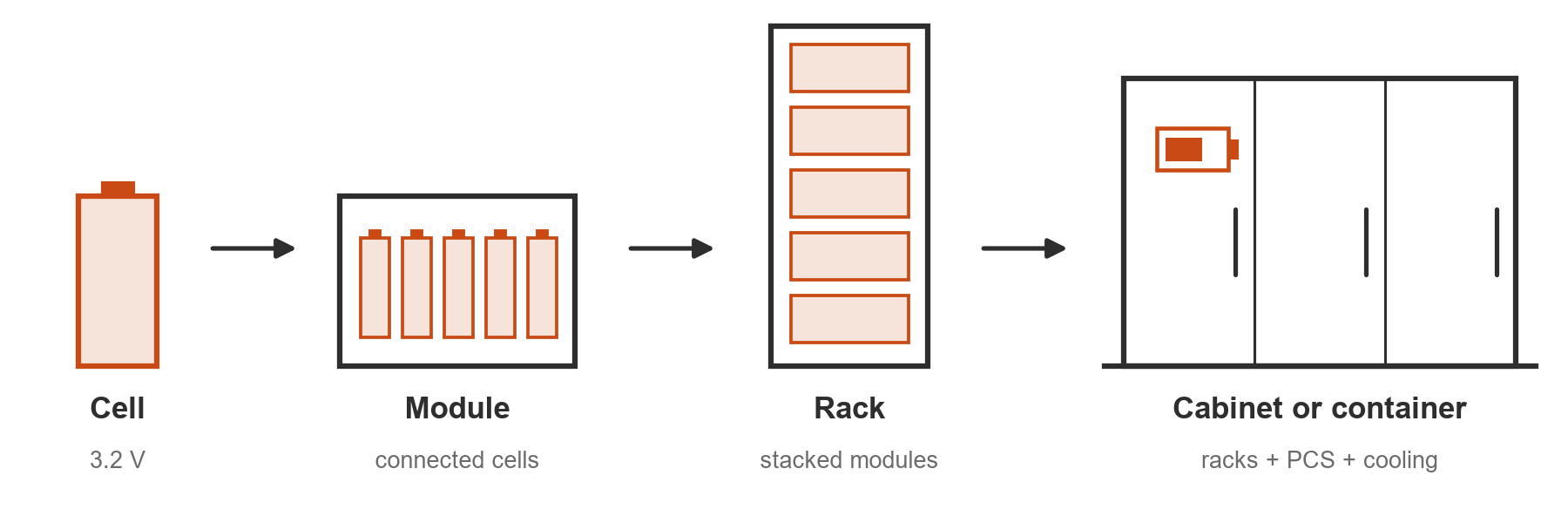 From a cell to a container: how a battery storage system is built.
Fun fact: most storage systems in the world use cells from just three manufacturers: CATL, BYD and EVE.
Two more parts matter: the PCS (Power Conversion System), which converts between the battery's DC and the grid's AC, and the thermal management system, which keeps the cells at the right temperature. Larger systems today mostly use liquid cooling: efficient and proven, but with more pumps, pipes and valves that need maintenance.
2. Power, capacity and C-rate
- Power (kW): how much the battery can deliver or absorb at any moment.
- Capacity (kWh): how much energy it can store.
- C-rate: power divided by capacity, i.e. how fast it charges or discharges.
Example: a 100 kW / 200 kWh battery has a C-rate of 0.5, so it fully charges or discharges in two hours.
3. Usable vs. nominal capacity (DoD)
Batteries are usually operated between about 5% and 95% state of charge (SoC), because full charging and full discharging speed up degradation. You lose part of the capacity (e.g. 90 kWh usable out of 100 kWh), but the battery lives longer. Batteries last longest when kept more empty than full, ideally around 25% SoC.
Always check whether the manufacturer quotes nominal or usable capacity. The difference can mean quite different revenues.
4. Round-trip efficiency (RTE)
You never get back all the energy you store. Typical RTE is 85–89% for a whole battery system, dropping by about 1 percentage point over the lifetime. Check whether it includes the system's own consumption for cooling and heating, which changes with outside temperature.
Suggestion: ask for the lowest possible RTE together with the maximum auxiliary consumption. That is the number your worst months will look like.
5. Degradation
Every battery loses capacity in two ways: calendar degradation (ageing, even when not used) and cycling degradation (from charging and discharging).
A datasheet may say 7000 cycles @ 70% EOL: after 7,000 cycles, capacity drops to 70%. But these figures usually don't include calendar ageing, and the lab test cycles look nothing like real industrial use of one or two cycles a day for many years. In practice, capacity after 10 years will be lower than the catalogue says.
Conclusion
Buying a battery storage system is not only a technical decision, it is a financial strategy. Check the usable capacity, the RTE including own consumption, and the degradation including calendar ageing, and you will know whether the battery will really create value, and for how long.
If you find this blog useful, please share it with others and let me know your thoughts on LinkedIn!