My PhD Paper: Why Train 1,000 Load Forecasting Models When One Will Do?
Imagine you are a distribution system operator with 1,000 measuring points: household smart meters and transformer stations of different sizes. You need a load forecast for each of them. The standard recipe is to train one LOCAL model per load and repeat it 1,000 times.
Most load forecasting work trains one LOCAL model per smart meter or substation. In our IEEE Transactions on Smart Grid paper, one GLOBAL model for 1,000 loads was:
- more accurate,
- trained faster,
- needed 12× less data and
- could forecast loads it had never seen.
Most of the forecasting models developed in the last 30 years are based on the LOCAL modeling approach, where you train ONE MODEL for each time series (measuring point).
In recent years, researchers at Google, Amazon and Uber have been using a different so-called GLOBAL modeling approach, where you train ONE big deep learning model for all time series at once.
Inspired by tech giants we are the first to bring the GLOBAL modeling approach to the energy industry.
My main PhD paper was written together with leading, world-renowned scientists:
- Yi Wang (University of Hong Kong)
- Qingsong Wen (University of Oxford)
Our research paper was also recognized as one of the most outstanding research achievements in 2023 by the Slovenian Research and Innovation Agency.
What is the difference between a local and a global model?
A local model learns from one time series only. Substation A gets its own model, substation B gets another, and they never share what they learned. Almost all load forecasting methods work like this.
A global model is trained on the samples of all time series stacked together. It is still univariate: to forecast substation A it only looks at the history of substation A. What is shared are the parameters, the learned mapping from "last week of load + calendar" to "next 24 hours".
Think of a local model as an apprentice who has studied one house for a year, and a global model as an engineer who has seen a thousand load profiles. Show the engineer a new house and they recognize the morning peak, evening peak and weekend shift immediately.
Why does this work for loads? Loads in a distribution network share the same calendar, routines and weather, and a transformer station is literally a sum of households. There is also a statistical reason: one year of half-hourly data is about 17,500 points per load, too few for a deep network. A global model has 1,000× more samples, so it can be bigger without overfitting.
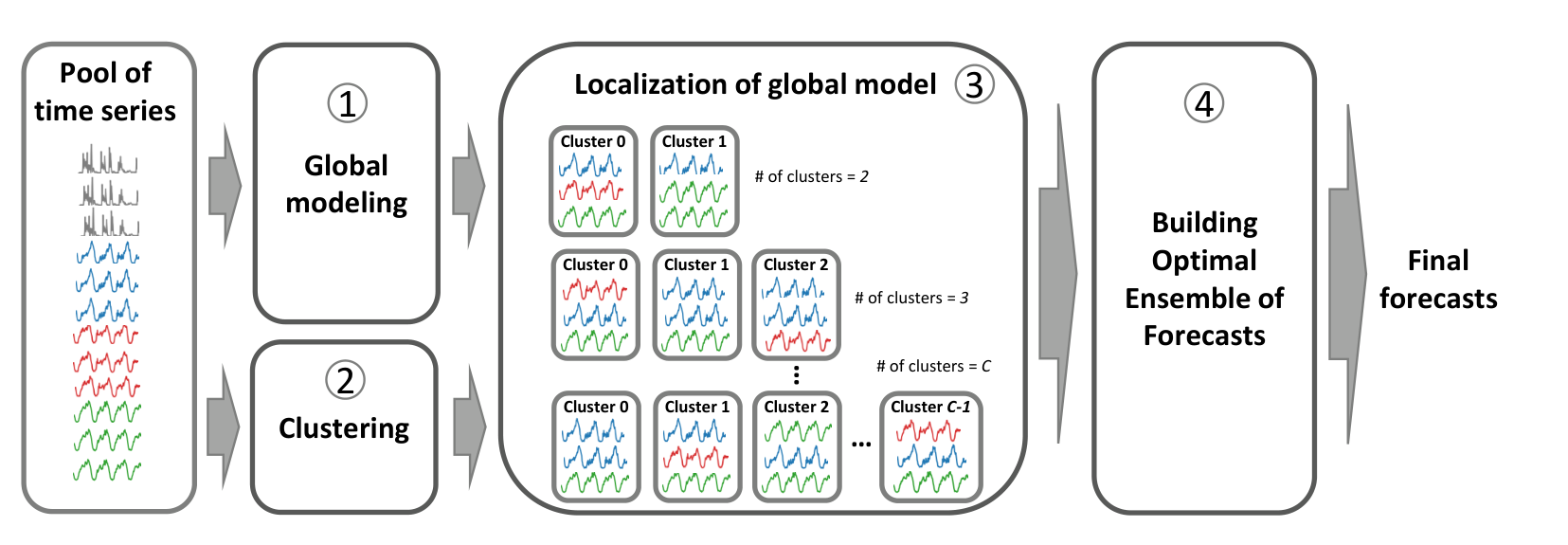
High-level overview of the proposed global load forecasting framework.
Is one model really better than a thousand?
We tested this on the public Irish CER smart meter data, from which we built 250 individual consumers and 750 transformer stations of 50, 100 and 200 consumers. The backbone was the N-BEATS deep learning model extended with calendar features, and errors were measured with MASE.
On average, the global model was 2.83% more accurate than 1,000 local models with the same architecture. More interesting is where:
- On transformer stations, it was better on 95–98% of the time series.
- On individual households, only on 35%. A household is volatile and very individual, and a single model is pulled towards the "typical" behavior. In the paper, we close this gap by fine-tuning the global model on clusters of similar loads (we call it localization).
Overall, every global model we tested (ours, N-BEATS, DeepAR, K-means-LSTM) beat every local one (linear regression, LSTM, N-BEATS).
What does this mean in practice?
The accuracy gains are a few percent. In my opinion, the practical properties matter even more:
1. It needs less data. With 12× less training data, accuracy dropped by only 0.35% and training time fell from 8 days to under 2. It still beat the local models trained on the full history. With the missing values and short histories typical of utility smart meter data, this matters a lot.
2. It forecasts loads with no history. On a completely new set of 1,000 time series, without any retraining, the global model was about 25% better than the naive benchmark. Retraining added only 0.8%. You can forecast a new consumer or transformer station after one week of measurements, while a local model typically needs a year of history.
3. It adapts to changes in behavior. Consumers install heat pumps, go on vacation, feeders get reconfigured. For a consumer whose load changed in October 2010, the local model kept predicting the old pattern, while the global model followed the new one, because it had seen similar patterns in other loads.
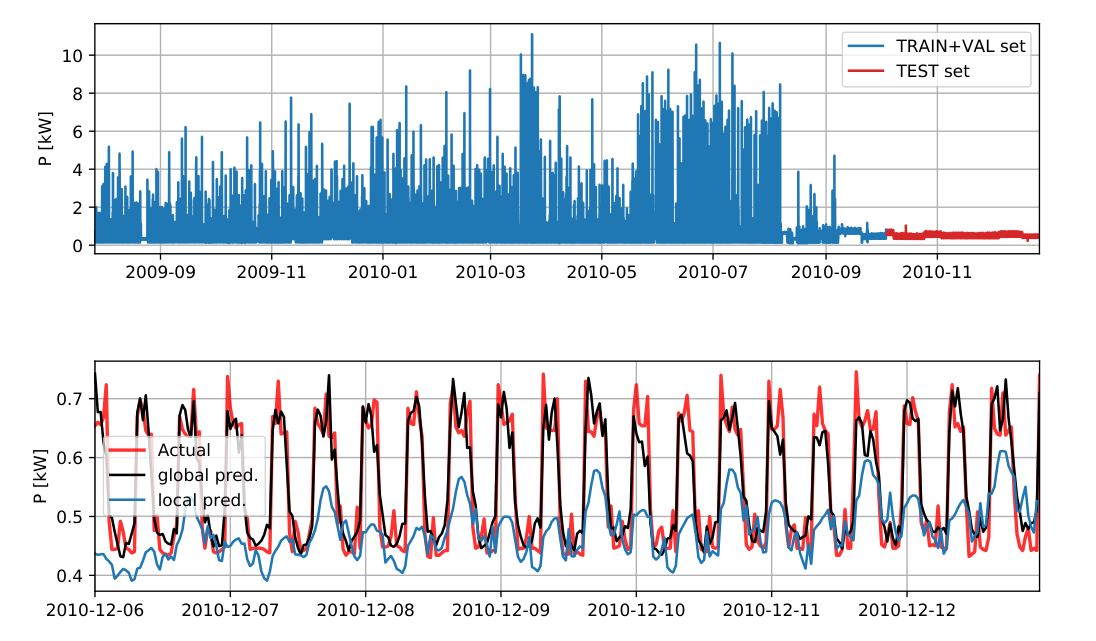
A consumer that changed behavior in October 2010. In December, the global model follows the new pattern, the local model is stuck in the past.
4. It scales. With 1,000 loads, training was 3.3× faster, and you maintain one model instead of 1,000.
If you have more than a handful of loads to forecast, start with a global model.
Conclusion
In distribution networks, don't ask "which model is best for this substation?" Ask "which model learns best from all my substations?"
Code and data are on GitHub, so you can try it on your own smart meter data.
If you find this blog useful, please share it with others and let me know your thoughts on LinkedIn!
If you want to connect with other experts working in this field, join my LinkedIn group AI in Smart Grids where I post about this topic!